nEdg
Galerie Roger Tator | Lyon, France | Sept-Dec 2009

Design: MARC FORNES / THEVERYMANY™
Production ($): Gallerie Roger Tator
Many thanks @Gallerie Roger Tator: Eric Deboos, Laurent Lucas, Marie Bassano
“n|Edg” as sum of its parts:
- 2 surfaces (Top & Bottom) - 2 people travelling - 4 suitaces from New York to Lyon - 81.6kg - 38.274 m2 - 22 sheets 4’*8’ Golden Aluminum - 6 days to CNC cut - 2796 individual panels (from 2 to n edges) - 2796 tags (3 to 5digits) - 5375 holes - 6500 rivets (or 13 boxes) - 5 rivet guns - 10 days assembly - 10 people


n|Edg
15 septembre au 15 decembre 2009 | Lyon, France (as part of "parcours raisonance" of the Lyon Art Biennale)
GALERIE ROGER TATOR 36, Rue d’Anvers 69007 Lyon T. (+33) 04 78 58 83 12 www.rogertator.com
La galerie Roger Tator bénéfi cie du soutien : du Ministere de la culture, Drac Rhône-Alpes, de la Région Rhône-Alpes et la Ville de Lyon.
Installation co-produite par Synesthésie

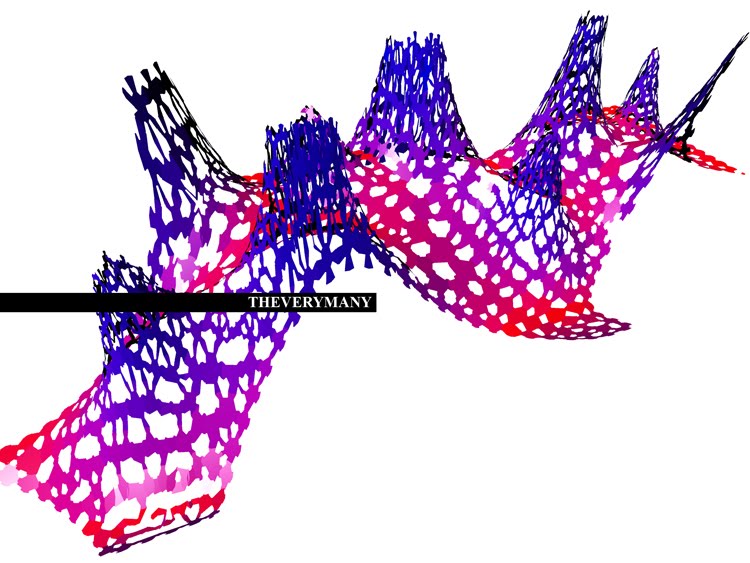
Above: top & bottom surface reconstruction
“n|Edg” assembly is written within continuous series of investigations at different scale:
- the overall: development of protocols of surface relaxation - in order for the surface to generate best fit curvature in response to fix hanging or support points (floor, ceiling, walls) as curvature - despite generating apparent complexity - also provides natural structural stiffness.
- surface description (or sampling): re-understanding the resultant surface as series of points - which densities are relative to the degree of curvature – the more curvature the more points and eventually parts.
- surface reconstruction (or tessellation): previous work focused on describing complex surfaces with flat components – after working for different “high end” architectural and design practices - the only way to keep pushing non standard environments is to introduce the economy of parts as part of the equation – therefore early tests were first looking at ways to triangulate complex surfaces – and therefore strategize on panels cut within flat sheets of material – which very quickly evolved toward what is now the trendy “arrays of quads” components paradigm. “n|Edg” is now investigating the reconstruction of a surface with polygonal parts going from three edges to (n) number of edges.
- informed customization: each part is similar though not identical – its change of size and proportion is therefore allows to describe different radius of curvature – but also local re-reading of orientation is driving the length and width of branches – the flatter, the wider in order to provide more surface alike coverage.

pattern extract
ASSEMBLY SEQUENCE:
[vimeo http://vimeo.com/8024565 w=100%&]